Friday, November 25, 2011

Report from the Fleeting Realm

As I was shelving books one day in the UBC a customer walked up to me and exclaimed: "I just LOVE the smell down here!" Admittedly, I've worked down here for a while and am honestly not so sure I can smell the UBC anymore. But it probably changes a lot, anyway. We get lots of new (used) books every week and plenty go out, too. I imagine the cumulative scent of aged paper, a little bit of dust--all the rooms and people that these books have sat with over the years--combines into one intoxicating smell. The smell of escape, pleasure and scholarship. It's not an entirely uncommon remark for a bookseller to receive from a customer: "I just love how books smell." I've even caught peeks of more than a few browsers sneaking a whiff inside an open book, but I'd never tell.

I have the same sort of associations. Sometimes the smell of one book will remind me of another, just like reading a really great description fills my brain with a smell memory. The brain is so wacky that way. One of my favorite books in the world is Perfume by Patrick Süskind. It's pretty gross. The main character Grenouille is born in a fish market next to a cemetery in 18th century Paris on a hot July day. Basically, the smelliest place on the smelliest day ever. After he's born, his skin makes no smell but his own sense of smell is superhuman. He can smell things at a distance, he can smell things concealed beneath wood, he can smell things humans usually can't. He can smell a certain je ne sais quoi on a young woman one night and becomes obsessed with the smell. Capturing her essence dominates his life and he becomes a journeyman perfumer in order to attempt it.

The narrator makes mention that all Grenouille's doings belong to the "fleeting realm of scent," and it's kind of crazy to think about how smell is so ephemeral, but our memories of scents and their immediate impressions are almost inescapable. I had a friend who had anosmia (no sense of smell) and every once in a while he would recall one of the two things he smelled before he lost his sense entirely: blue kool-aid. We were walking together one day and randomly he said, "does this tree smell like blue kool-aid?" I took a whiff to humor him, but alas it just smelled like cedar. "Darn, I can smell it so strongly. I could swear I was smelling it for real."

In Diane Ackerman's A Natural History of the Senses, she spends a bit of time talking about literary entanglements with scent: Proust, Dickens, Lady Murasaki. It's a sense that can be overlooked in writing, but when it's given its full due, it can really be so evocative. I have only to read the world lavender, or vanilla or citrus and immediately my brain is reminding me what those things smell like. When authors throw scents into a book it immediately draws me in. I'm alert, attentive and my mind is exactly where they might want me: disgusted and near-wretching in the fish market or peacefully reclining in a pleasant garden. But sense all this for yourself! Stop by and smell our wares, and check out one of the many books that recall this fleeting realm.

Wednesday, November 23, 2011

You are Invited to Travel To...

For many Brookliners, the smell of turkey in the air, whether it be November or December, means a lot of travel.  When I was six, I never understood why I couldn't take puzzles with me.  Of course I wouldn't loose the pieces...but there was also the issue of the box.  It's a standard, puzzles come in boxes.  It is also a fact that if you place a box with a lot of small pieces in it, it will result in a very squished and ripped up box.  All in all, not good.  That is why some of our bestselling kids' puzzles are very intriguing.  Why?  Well, to begin with they come in a resealable bag.  And they measure 8x12, which is a little smaller than the size of most airline and train fold-out-trays.  Introducing Travel Pouch Puzzles, that come in a variety of designs -- dragons, ballet, space, USA, world, horses, pirates, ocean, and more!


And if you are still reading, I'll let you in on a secret.  Our selection of these Travel Pouch Puzzles will be 15% off Thursday, December 1st only, AFTER our First Annual Staff Recommendations at 7:00 pm, downstairs in our Readers and Writers space.  (Staff Recommendations for grown-ups will take place on Wednesday, November 30 at 7:00 pm.)  What other new and recent titles and gifts of the year will we be recommending (all at 15% off)?  You'll have to come and find out. 

You won't want to miss this event!  Come join us for an inspiring evening of refreshments, wine, and literary discussion to discover the perfect gift or select your next winter read.  Complimentary wrap will also be available.

Tuesday, November 22, 2011

Destination: Home

As Thanksgiving approaches, our minds fill with the people we are grateful for, those who make up our everyday, those we keep close despite the distances between us. In an effort to bridge those distances we book our flights, stand in security lines, sit in hours of traffic, or send cards and gifts in our absence. On Thanksgiving, we become pilgrims again, traveling back to the places from which we come, or to the places that are growing dear, to the places that inspire us.

Unlike her previous work--capturing the Rolling Stones or a pregnant Demi Moore, Annie Leibovitz's newest book of photography, Pilgrimage, does not contain any people. Instead Leibovitz travels to the places that inspire her: the places where the pioneers of various fields of literature, photography, and art once lived, worked, composed.

As you flip through the pages, rich with portraits of place, you will not miss the people. There is no absence in this book. Somehow, in capturing these abandoned objects, empty rooms, and open landscapes, Leibovitz has managed to reveal the presence of those no longer there almost as powerfully as if they were staring back at the lens.

My favorite image, the two-page spread of the top of Virginia Woolf's writing desk, tells me more about that writer's process than I could get out of reading a 200 page biography. Introspection adorns the delicate intricacies revealed in a close-up of Emily Dickinson's white dress. A bullet hole that Annie Oakley shot through a heart target appears to be freshly torn.

Leibovitz's project began with family. During a difficult year, she set aside time for her children, taking them on vacation to Niagara Falls. As her two girls stood on a precipice overlooking the falls, Leibovitz wandered up behind them, camera in hand. She saw what mesmerized them and snapped the photo that now adorns the cover of her book. Behind every photograph of place is an image of someone she loves.

Happy travels.

Friday, November 18, 2011

Dig In!

Thanksgiving is coming up next week, and what better way to celebrate the tastiest holiday in America with a blog post composed entirely of me skipping ahead to the sauciest bits in the foodiest books in the UBC? Bon Apétit!

Goblin Market, Christina Rosetti
"I ate and ate my fill,
Yet my mouth waters still;
To-morrow night I will
Buy more," and kissed her.
"Have done with sorrow;
I'll bring you plums to-morrow
Fresh on their mother twigs,
Cherries worth getting;

You cannot think what figs
My teeth have met in,
What melons, icy-cold 
Piled on a dish of gold
Too huge for me to hold, 
What peaches with a velvet nap,
Pellucid grapes without one seed:
Odorous indeed must be the mead
Whereon they grow, and pure the wave they drink,
With lilies at the brink,
And sugar-sweet their sap."

Farmer Boy, Laura Ingalls Wilder:
"Almanzo ate the sweet, mellow baked beans. He ate the bit of salt pork that melted like cream in his mouth. He ate the mealy boiled potatoes, with brown ham-gravy. He ate the ham. He bit deep into velvety bread spread with sleek butter, and he ate the crisp golden crust. He demolished a tall heap of pale mashed turnips, and hill of stewed yellow pumpkin. Then he sighed, and tucked his napkin deeper into the neckband of his red waist. And he ate plum preserves and strawberry jam, and grape jelly, and spiced watermelon-rind pickles. He felt very comfortable inside. Slowly he ate a large piece of pumpkin pie."

The Devil's Larder, Jim Crace
"She liked the aubergine's affinity with olive oil and garlic, its generous response to mushrooms or tomatoes. It kept good company. She liked its versatility, just as happy to be stuffed as fried, just as tasty in a moussaka or ratatouille as in a dip or served as Fainting Priest."

The Bell Jar, Sylvia Plath
Yeah I know they all get poisoned from the crabmeat but OMG this is the tastiest spread in literature:

"Arrayed on the Ladies' Day banquet table were yellow-green avocado pear halves stuffed with crabmeat and mayonnaise, and platters of rare roast beef and cold chicken, and every so often a cut-glass bowl heaped with black caviar. [..] Before I came to New York I'd never eaten out in a proper restaurant. I don't count Howard Johnson's, where I only had french fries and cheeseburgers and vanilla frappes with people like Buddy Willard. I'm not sure why it is, but I love food more than just about anything else. [...] My favorite dishes are full of butter and cheese and sour cream."

Like Water for Chocolate, Laura Esquivel
This book! Recipes in every chapter and saucy descriptions like gangbusters! Here's a teaser:


"It was as if a strange alchemical process had dissolved her entire being in the rose petal sauce, in the tender flesh of the quails, in the wine, in every one of the meal's aromas."

A Movable Feast, Ernest Hemingway
"As I ate the oysters with their strong taste of the sea and their faint metallic taste that the cold white wine washed away, leaving only the sea."

The Book of Salt, Monique Truong
Photo ©Rebecca Perriello
"I wanted to tell her that I would cut the first pineapple into paper-thin rounds and saute them with shallots and slices of beef; that the sugar in the pineapple would caramelized during cooking, imparting a faint smokiness that is addictive; [...] I would cut the second pineapple into bite-sized pieces, soak them in kirsch, make them into a drunken bed for spoonfuls of tangerine sorbet; that I would pipe unsweetened cream around the edges, a ring of ivory-colored rosettes."

Thursday, November 17, 2011

Lynda Barry love, animals getting drunk, did I mention I'm an art school dropout?

I was a very creative little kid, which led to a lot of kits, and journals, (I believe I've blogged about those before) and various arts-n-crafts situations from distant family members. Some I used, some I didn't. I didn't really like other kids, I found most of their shenanigans insufferable, so I spent a lot of time doing stuff in front of the television or listening to books on tape. Creating stuff always came pretty naturally to me as a child, and then I grew up and went to art school (for a hot second) and found it really very difficult. Art school wanted me to investigate why I created, and how I could better that instinct, and most importantly, how I could make money off of that instinct. Those are all really important things to think about if you're pursuing art as a serious career; I have been working for Abstraks, which is an online art journal run by my friend Darius Loftis, in an interviewing capacity. In my work interviewing artists, I've found you really have to know you're stuff if you're planning on making this into a career choice.

I remember once in Art school, in one of my foundation classes, I spent hours making this digital collage that was supposed to reference this science fiction genre of comparing space to the final frontier, (this was a thinly veiled excuse to talk about my favourite television series of all time, Firefly, which is about space cowboys) and I was psyched about using photoshop, something I had been teaching myself in my own time since high school (so now that I'm reading this I'm realizing that I am the hugest nerd in existence and should probably just be stopped). I spent so much time crafting this complicated vista of vintage photographs and stills from movies like "The Good, the Bad, and the Ugly" and "The Lone Ranger", and I really tried very hard to make this thing that spoke to my interests in a format that I understood, and of course, the teacher didn't get it. It was about space? But cowboys? What was the deeper meaning here, what did space and cowboys represent to me? I was incredulous. My narrative was falling on deaf ears, but more than that, I myself didn't really know what I was talking about, and I had hoped that art school would help me figure that out. When it didn't, I left.

I never stopped thinking about it, though. I don't know why I personally create. Some of us don't, I suppose. To some of us it might just be a natural form of communication; my parents are both quietly creative, my mom writes a little, my dad is a master color-er. I learned pretty early that art makes people happy; not necessarily the content, but the fact of art. Draw somebody a picture sometime, watch their reaction. It doesn't have to be what you would call "good". Around here I'm known as a pretty serious doodler. I recently made some silly art for a friend's kitchen, and she remarked that her last apartment had practically been a museum for another artist friend. I said, "You should make your current place into a similar museum; Billy-Bob (names have been changed to protect the innocent) is a much better artist than I am." My friend replied, "Billy-bob is a very good painter, but she's not as silly as you. Much fewer animals getting drunk." Sure enough, there's a monkey in a bow tie drinking a glass of wine on the piece I made for her. It's not fine art, but its definitely a line drawing of a monkey drinking a glass of wine. Just the fact that it's good for nothing else makes it art, and I stand by that sentiment. And when she looked at it, she got jazzed about that monkey drinking that wine. Come on! It's a monkey drinking wine! What's not to love?

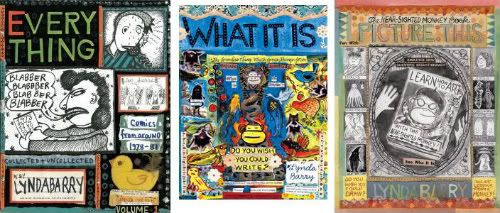
The point I'm getting at is: Art don't always have to be beautiful, friends. I don't mean in the feelings department; sure, art can be used to manipulate emotions in a bevy of different ways, and I don't mean to shock you, but sometimes art is not meant to make you feel good. But you guys aren't dummies, you know that, you've listened to Joni Mitchell, you know the drill. I'm just worried that sometimes we don't let ourselves create because we think what we're going to create is going to be 'bad' or not look good. If that's you, then let me hip you to the groove of one Lynda Barry, author of these books and a few more:


Lynda Barry gets me, you guys. I've mentioned her on here before on my list of Greatest Booksmith Author Events I've Ever Attended, and she is truly the queen of creation. Barry addresses any and all of your qualms about Makin' Stuff and Bein' Artsy, not only does she address them but she lets you in on her own creative angst, to boot. Her creative angst! This, from an amazing woman who's published several graphic novels and a few fictional ones. And yet, she too, lets herself get in her way sometimes. I love Lynda Barry, I hope everyone who longs to make stuff reads her books and starts a-makin' in their own way, at their own speed. The books themselves are pretty gorg, too boot - I'm batting my eyelashes at you, gift book lookers-for. Yeah. You heard me. I would get this for any Empty Nesters Looking To Expand Their Suddenly Free Time and Young Family Members That Sorta Like Reading And Being Alone. I'm totally kidding, you see right through me, internets. I would get these books for anyone, ever, that's how much I love them. I don't just love them, I loooooooooooove them. I wanna leave an anonymous note in their locker and then never make eye contact with them again for as long as I live. You know, usual adult stuff. You know.

Tuesday, November 15, 2011

Destination: A White Whale

Even those who have not made it all the way through Moby Dick (I currently have three people in my life who have never finished, all of whom will remain nameless, but one is my father, one is my boyfriend, and one is a coworker who shares my middle name), even if you've never done anything more than heft the book off the bookstore shelf for a moment before setting it back down and rubbing your strained muscles, you probably know that Moby Dick is a white whale whose evasive nature has made him the perfect metaphor for, well, anything.

In fact, perhaps the most prevalent meaning of Melville's white whale is the enigmatic nature of the beast itself. Lately though, Moby Dick has been anything but elusive. He's everywhere at Booksmith. Choose almost any section and you'll find him: from art books to pop-ups, fiction to destination literature, U.S. history to children's books, Melville is becoming a presence in bookstores difficult to ignore.

Why? In a recent article published in The Rumpus, Roary Douglas claims Moby Dick maintains its popularity for the fact that someone could write an essay for every page of the book. David Foster Wallace, apparently, wrote three essays on one chapter. Douglas's essay is about Moby Dick as travelogue, which is exactly what it is. I challenge anyone to read the first chapter (come on, just the first) without making a trip to the seashore, or booking a whale watching cruise, soon after.

Still struggling to find an essay in every page? How about a drawing? Matt Kish recently published an art book the heft of Moby Dick, in fact, it contains the same number of pages. In Moby Dick in Pictures Kish has created a work of art for each page in the novel. An impressive task. For example, how would you illustrate: For so revolvingly appalling was the white whale's aspect, and so planetarily swift the ever-contracting circles he made, that he seemed horizontally swooping upon them?

If you like the visual approach to so much text, there is a pop-up in our kids' section. Or you can try the Classic Starts version in children's books. This is part of a new series that strives to make classic literature palatable for beginning readers.

Skeptical that a narrative as intricate as Moby Dick could be translated into juvenile language, I took a look at how Classic Starts chose to "retell" the story. The book, thankfully, preserves the first line, and even the one that soon follows about Ishmael feeling so restless that he wanted to knock the hats off of people's heads: so far, so good. Plus, you only have to wait until chapter six (as opposed to twenty-eight) to finally meet the infamous Captain Ahab, and the entire book is only 141 pages. Any references to spermaceti, however, are excluded.

When I first read Moby Dick a little over a year ago, I read Phillip Hoare's The Whale simultaneously. The book just came out in paperback this year and is a wonderful supplement to those readers who get hooked on all the whale facts artfully woven into Melville's narrative. Hoare takes you from his experience swimming with whales to the Whaling Museum in New Bedford (where you can also find Melville sights such as the Seamen's Chapel, lined with memorials to men who lost their lives to whales and complete with a pulpit that looks like a ship's prow).

And if you are more interested in the life of the author, try Jay Parini's novelization of Melville's life, Passages of HM, released this month in paperback.

Still not convinced you want to pick it up? Start with Nathaniel Philbrick's new book Why Read Moby Dick, and if he doesn't convince you, I give up. Philbrick has written on this subject before—his In the Heart of the Sea tells the true story of the Essex, the whaling boat whose tragic tale inspired Melville to write his novel.

These books all orbit around the novel, much in the same way Melville describes a pod of whales circling their young. Even outside of the bookstore, I'm surrounded by references to the novel. My copyediting class was assigned a passage from Melville to proofread. And last week, a play of Moby Dick was even showing at the Paramount. I tried to go, but it was sold out. The white whale wins again.

Friday, November 11, 2011

What's all the noise?

Books may not make a whole 'lotta noise on their own, except maybe for the satisfying sound of a cracking spine (BOOK spine!). But books can certainly be splendiferously sonorous: great volumes of poetry and well-written children's books BEG to be read aloud and shared, and just as many books are the conveyances of great music or the science thereof. Below are a few recent finds in the Used Book Cellar that showcase the gamut of sound-related books for part two of my little blog-series on UBC finds and the senses...


The Singing Life of Birds
 by Donald Kroodsma is a book on how to listen to bird's sing. You wouldn't think you'd need to read a whole book weighing in at 400-some-odd pages, but this bad boy delves deep into the science of bird songs, as well as differences in songs among many types of birds. It even comes with a CD to follow what Kroodsma is talking about. It's a beautiful hardcover in fantastic condition that would make an excellent gift for the avian audiophile in your life.


Just a Little Critter Collection
by Mercer Mayer is a a collection of seven of the Little Critter books all in one volume. No more reaching for another and then another when the little one(s) cry "MORE!" - the crème de la crème of America's favorite monster are all handily bound in a not-unwieldy volume. Whenever I think of read-alouds, the first that comes to mind is Little Critter. Of all the books in my library as a child, Little Critter were my mom's favorite to read over and over, (HI MOM!) and perhaps that's why I have so many fond memories of her voice reading the refrains ("I was so mad!") when I think of childhood, books, or nondescript lovable critters. Pick up a copy and make it your family's bedtime favorite.

Vermont Sings is a tiny pamphlet of sheet music printed in 1959. It has great lettering throughout and a lovely illustration on the cover. The songs within all celebrate the awesomeness of Vermont, and there are even a few songs in French and German. It's a great little find that celebrates music AND The Green Mountain State. Win!

That's all from the UBC this week, folks, thanks for reading. If'n you have any books to sell, be sure to bring them by Wednesday through Saturday, 10 AM-4 PM. Tune in next week when I celebrate all things tasty for the Thanksgiving holiday.