Superbowl, schmuperbowl.
:Duck the angrily lobbed cheese curls of a region full of angry Patriots fans:
Sorry. Let's start again. I hear there's an exciting game on tonight. However, personally, I'm more interested in following another competition: School Library Journal's Battle of the Books.
The concept is simple: take a bunch of kids' books from the past year that had some form of "buzz." Assign brackets to some of the best authors in the business (judge list TBA). Let the games begin.
Come on, Inside Out and Back Again. Keep it going.

Sunday, February 5, 2012

Saturday, February 4, 2012
Pre- Super Bowl Flash Contest ($, poetry, FAME)

Ok, take a receipt (from us)
- write a short poem/ flash fiction on the back of it
- send it to me
Kate Robinson
279 Harvard Street
Brookline, MA 02135
The winner will get:
- a gift certificate
- a book of poetry
- their poem on our FB and blog.
You have till February 10th (postmarked) or just hand deliver it.
Go Pats!!!!!!

Friday, February 3, 2012
Mexican Constitution Day!
February 5 marks Mexican Constitution Day, and what better way to celebrate than to (re)discover a fascinating Mexican artist?
Until a customer brought in a Dover clip art book of Posada's illustrations, I'd never seen his work before! How drab my life had been until now! Jose Posada was a printmaker and engraver who worked mostly during the 19th century. He created a lot of illustrations for Mexican tabloids, so while there are really great illustrations of goings-on in late 19th - early 20th century Mexico, there are also a grip of illustrations of folk stories (like a lady rumored to give birth to three children and four animals!), pop-art skeletons, advertisements and scenes from the Mexican revolution that are fascinating and detailed.
Here are some examples:


 The UBC got in a Dover clip art book that can be yours for just $3.50, it's a larger format so you can see all the engraving details. We also got in a little box that has a tiny hardcover book of illustrations in addition to several postcards and full-size reproduction posters, all in mint condition. That one's $13. Great gifts, great coffee table items, a great way to celebrate Mexico's sovereignty!
Until a customer brought in a Dover clip art book of Posada's illustrations, I'd never seen his work before! How drab my life had been until now! Jose Posada was a printmaker and engraver who worked mostly during the 19th century. He created a lot of illustrations for Mexican tabloids, so while there are really great illustrations of goings-on in late 19th - early 20th century Mexico, there are also a grip of illustrations of folk stories (like a lady rumored to give birth to three children and four animals!), pop-art skeletons, advertisements and scenes from the Mexican revolution that are fascinating and detailed.
Here are some examples:


Thursday, February 2, 2012
A Better Class of Garbage.

When I was a kid, there were a few movies that were non-negotiable in my house. My parents are both major cinephiles, so collectively we owned a lot of VHS tapes, and spent a lot of time watching movies and reading, respectively. One of the best things about my mom is that she has no criteria for what constitutes a "worthy" piece of media. She loves sappy romance movies, horror movies, old movies, she has shown me some of the best and worst films I have ever seen. I remember one year, for mothers day, I invited her over to my apartment and we got barbecue take out and she picked two DVDs for us to watch, and as my gift to her, I would watch whatever she picked without complaint. That Mothers Day I watched "Cloverfield", a sci fi thriller type about a monster that destroys New York City, and "The Holiday", a droopy romantic movie in the romcom style starring Jack Black, Kate Winslet, and other adorable starlets. Was my Mom the only 50 something woman seeing "Cloverfield" in the theater by herself when it debuted? I'd wager she was.

She showed me "A Thousand Clowns" when I was probably about 12, and ever since, this has been my favourite movie. It's purely character driven, based off of a play by the same name written by Herb Gardner. It's a story about Nick (played by Barry Gordon) and his uncle Murray (played by Jason Robards) whom he lives with and who is currently unemployed. The story is basically about how eccentric Murray must find ground between captaining his own alternative lifestyle (also known as unemployment) and being a good father and provider for Nick. It's basically a movie about having to grow up, just a little bit, and about negotiating how much of your personality and personal goals you should auction off for the sake of assimilating into a larger, but safer, culture.
The movie appeals to me because I don't really care about a plot; I'm a total character person. The movie probably has 4 or 5 different locations, I would say about 75% of it takes place in Nick and Murray's apartment. It's a flurry of quick dialogue, little quiet jokes, and meaningful looks. So of course, I love it. A Very Popular Website Whose Name We Dare Not Speak but Could Be Related To Certain Rainforests in South America just released the film on DVD, so I bought it immediately as a birthday present to myself. I'd like to recommend this play or movie to anybody that has ever had values that did not fit in with everybody else, to anyone that is creative or successful in a way that is not necessarily fiscally lucrative, or to people that bummed around a lot with their Dads and/or older, male role models when they were kids. The idling at the park and complicated inside jokes will strike those of us that spent a lot of time goofing off as charmingly familiar. I just want us all to think a little bit more critically about what constitutes "a waste of time", and why. Can you explain it? Is it about money or activities to hone potential money making skills? How much time do you have to 'waste' before you have 'wasted' time? As a fairly nonplussed and apathetic student and super passionate and creative doer-of-art and thinker-of-things, I'm curious about these questions, and "A Thousand Clowns" definitely got me thinking about them at a young, ripe age.
The movie appeals to me because I don't really care about a plot; I'm a total character person. The movie probably has 4 or 5 different locations, I would say about 75% of it takes place in Nick and Murray's apartment. It's a flurry of quick dialogue, little quiet jokes, and meaningful looks. So of course, I love it. A Very Popular Website Whose Name We Dare Not Speak but Could Be Related To Certain Rainforests in South America just released the film on DVD, so I bought it immediately as a birthday present to myself. I'd like to recommend this play or movie to anybody that has ever had values that did not fit in with everybody else, to anyone that is creative or successful in a way that is not necessarily fiscally lucrative, or to people that bummed around a lot with their Dads and/or older, male role models when they were kids. The idling at the park and complicated inside jokes will strike those of us that spent a lot of time goofing off as charmingly familiar. I just want us all to think a little bit more critically about what constitutes "a waste of time", and why. Can you explain it? Is it about money or activities to hone potential money making skills? How much time do you have to 'waste' before you have 'wasted' time? As a fairly nonplussed and apathetic student and super passionate and creative doer-of-art and thinker-of-things, I'm curious about these questions, and "A Thousand Clowns" definitely got me thinking about them at a young, ripe age.
Wednesday, February 1, 2012
It's history for some, heritage for others
Welcome to the month of February. Doesn't feel like February, does it? Today Jamie, a fellow children's bookseller, made the comment that the weather has been too hormonal lately. I mean, 20 to 60F? That's so crazy! Good thing weather does not effect celebrations, well at least not this one: welcome to Black History Month!
If you know my taste, you will now that with the exception of Christmas, I am not a fan of holiday books. They're usually too cutesy or televised or just horribly written. But, over the years, I am finding that books depicting Black History are quite different. They are all unique and many of them read as true literature. It is clear that these authors and illustrators take a great deal of pride in their work. There is also a great variety. From slavery to civil rights to strong world leaders (and this is just covering our non-fiction section, not fictional novels) there's so much to learn!
Our Children Can Soar by Michelle Cook
 Though it may seem simple on the surface, this picturebook covers more than a list of important names, "Jackie [Robinson] scored... so Rosa [Parks] could sit. Rosa sat...so Ruby [Bridges] could learn."
Without one person, such as the first African American baseball player changing the world, who's to say that Rosa Parks wouldn't have had the courage or inspiration to change the world? Or to inspire a little girl who wanted to go to school. History does not document a relationship between these people specifically, but it is the theme they share that inspires others to fight segregation and live freely. (ages 4-8)
Dave the Potter: Artist, Poet, Slave by Laban Carrick Hill -- Caldecott Honor 2011, Coretta Scott King Illustrator Award 2011
 "To us / it is just dirt, /the ground we walk on... / But to Dave / it was clay, / the plain and basic stuff / upon which he formed a life / as a slave nearly 200 years ago." Dave, though he was a slave, had the education and knowledge to write brilliant poetry and skillfully create amazing pottery. In Hill's own words, "Dave created his art in spite of a society that not only discouraged his brilliance but threatened him with death for expressing it." (ages 4-8)
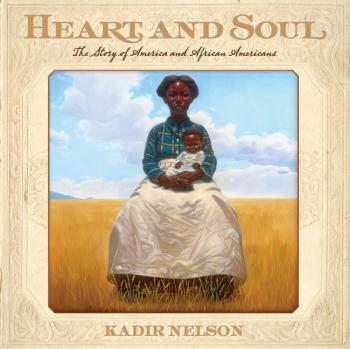
Heart and Soul: The Story of America and African Americans by Kadir Nelson -- Coretta Scott King Author Award and Illustrator Honor 2012
 This is the quintessential history book -- from where we are today, from slavery to the Abolition, to finding freedom in the aftermath of slavery and public views of "coloreds," to great leaders, heroes, and accomplishments...our history cannot be overlooked no matter what race you were born in to. (ages 9-12)
Coretta Scott by Ntozake Shange
Some of you may know her as just the name of an award. Did you know that she was Martin Luther King Jr.'s wife? But this picturebook shows far more than their relationship. Shange's poetry focuses on Coretta Scott King's hardships of growing up and striving for change in a world of indifference. "No matter who we are / and the Negroes are no different / but fervor for the coming vote / and equality / pushed Coretta a peace and wonderment / of the Lord / 'ain't gonna let nobody turn me round / turn me round.'" (ages 6-9)
If you know my taste, you will now that with the exception of Christmas, I am not a fan of holiday books. They're usually too cutesy or televised or just horribly written. But, over the years, I am finding that books depicting Black History are quite different. They are all unique and many of them read as true literature. It is clear that these authors and illustrators take a great deal of pride in their work. There is also a great variety. From slavery to civil rights to strong world leaders (and this is just covering our non-fiction section, not fictional novels) there's so much to learn!
Our Children Can Soar by Michelle Cook

Without one person, such as the first African American baseball player changing the world, who's to say that Rosa Parks wouldn't have had the courage or inspiration to change the world? Or to inspire a little girl who wanted to go to school. History does not document a relationship between these people specifically, but it is the theme they share that inspires others to fight segregation and live freely. (ages 4-8)
Dave the Potter: Artist, Poet, Slave by Laban Carrick Hill -- Caldecott Honor 2011, Coretta Scott King Illustrator Award 2011

Heart and Soul: The Story of America and African Americans by Kadir Nelson -- Coretta Scott King Author Award and Illustrator Honor 2012
Coretta Scott by Ntozake Shange

Some of you may know her as just the name of an award. Did you know that she was Martin Luther King Jr.'s wife? But this picturebook shows far more than their relationship. Shange's poetry focuses on Coretta Scott King's hardships of growing up and striving for change in a world of indifference. "No matter who we are / and the Negroes are no different / but fervor for the coming vote / and equality / pushed Coretta a peace and wonderment / of the Lord / 'ain't gonna let nobody turn me round / turn me round.'" (ages 6-9)
Come peruse our non-fiction with over 20 titles!
Tuesday, January 31, 2012
Destinaton: Walden Pond
 Last week, after closing up Booksmith one night, I discovered that the 66 bus, whose reliable service I often depend upon to take me home to my apartment in JP, would not be at Coolidge Corner for another 33 minutes. Tired after a day of work, I sighed, left the bookstore, and began walking.
Knowing I had a 40 minute trek in front of me, I took out my cell phone. I considered it too late to call anyone in Boston, but none of my friends on the West Coast were answering. So I was stuck with myself for company on my late night walk home, with nothing but my thoughts and the abandoned streets of Brookline to keep me company.
 As I crossed Beacon and headed down Harvard, I began thinking about the books waiting at my bedside for me, if ever I made it home: W.G. Sebald's The Rings of Saturn, Teju Cole's new novel Open City, and the recently re-published Conversations with Kafka by Gustav Janouch.
By the time I reached South Huntington, I had realized something. All three of these books were connected in a way I had never before recognized. Each of their deeply meditative narratives draw inspiration from the same activity: walking.
 W.G. Sebald's narrator takes a walking tour of East Anglia, but his reflections travel far from England's shores, deep into the dark heart of imperialism in Africa, to the silk trade in China, and back to England's landscape, seamlessly weaving together fact and fiction as he excavates deep into England's history and culture.
 Open City has a similiarly ponderous pace. "And so when I began to go on evening walks last fall, I found Morningside Heights an easy place from which to set out into the city," begins Cole's narrator, an Ethopian med student in New York City. "These walks, a counterpoint to my busy days at the hospital, steadily lengthened...in this way...New York City worked itself into my life at a walking pace."
And in Conversations with Kafka, Janouch's narrator--himself as a seventeen-year-old budding poet who has just been introduced to Franz Kafka by his father, a co-worker of Kafka's at Workmen's Accident Insurance Institution--demonstrates that walks are not only fuel for the reflective mind, but can also pave the way into deep discussions with a companion. When not conversing over Kafka's desk at the insurance company, the two escape into the streets of Prague.
 |
Janouch's book was republished by New Directions
with cover illustration by Maira Kalman
and introduction by Francine Prose.
|
"I often marvelled at Kafka's wide knowledge of all the varied architectual features of the city," Janouch reports, "He was familiar not only with its palaces and churches but also with the most obscure alleys of the Old Town."
As the two roam the streets, what unfolds is not unlike a kind of Socratic dialogue, only more plausible and less didactic. The conversation of the young poet and his mentor, the darkly introspective novelist Kafka, flourishes on the city streets, fed off of the youth of one, the experience of the other, and the exhilaration of a good walk down the familiar yet ever-revealing streets of one's own city.
 Inspired, a few days later I found myself pacing out the circumference of Walden Pond with a companion. When our conversation flagged, our thoughts were consumed with the fresh pine-scented fragrance of the air around us or with the minute gradations of gray on the thinly frozen pond. On the train ride back to Boston, we read passages of Henry David Thoreau's essay, "Walking," aloud to one another. "I have met with but one or two persons in the course of my life who understood the art of Walking," Thoreau writes, "who had a genius, so to speak, for sauntering."
While I am not sure I have mastered the art of walking yet myself, in the meandering prose of these books I have found mentors and companions, fellow saunterers whose perengrenatious musings inspire me to skip the bus more often, to know the streets of my city through the soles of my feet.

Friday, January 27, 2012
Classic Combinations
Peanut butter and jelly. Chocolate and peanut butter. Peanut butter and crackers. There are combinations of things so genius, so beautiful, that they withstand the test of time. And then there are combinations that are new--unseen to this earth--so brilliant that one wonders why it wasn't thought of sooner. Gobs of these genius combinations floating around the UBC are waiting to be discovered by you, our humble browser. Observe:
Pandas and Antlers
from a Parisian guidebook on our DOLLAR CART, people.

Corn cobs and Edvard Munch
I'm pretty sure this was on the original canvas, it just got cut out because of some vast Norwegian government conspiracy.

Dali and tarot
So obvious. So cool. A whole book of images; surrealism meets esoterica.

Subscribe to:
Posts (Atom)